

A Collaboration Invitation Leads to a Channel Disappearance
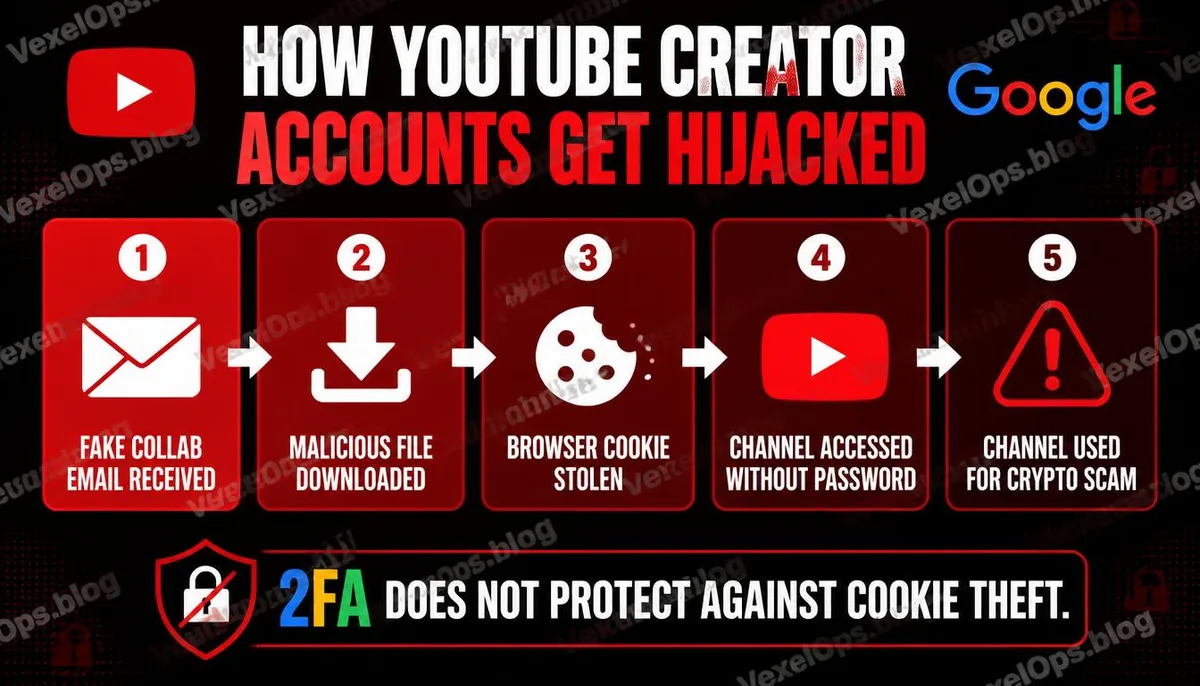
The method by which YouTube creator accounts are hacked has formed a relatively fixed pattern over the past few years. Victims receive a professionally looking email claiming to be from a brand or tool provider, offering a collaboration opportunity or a free product trial, often with an attached contract document or product presentation that requires downloading. Behind this attachment or link is malware designed to steal browser login cookies. Once the cookies are obtained, the attacker does not need to know the password or pass two-factor authentication to log into YouTube Studio as you, delete or make all the channel’s videos private, change the channel name and icon to cryptocurrency scam content, and then start live streaming a fraud impersonating a famous person. The whole process can be completed in a matter of minutes, during which you might be completely unaware that anything is happening. Further reading: What Is a Discord Token? Why It's Often Related to Account Hacks
How Cookie Theft Attacks Bypass Two-Factor Authentication
This is the most confusing question for many when they hear about their channel being hacked—despite having two-factor authentication enabled, why were they still hacked? Two-factor authentication protects the act of logging in itself, requiring an additional verification code after entering the password. However, once you successfully log in on a device, the browser stores a set of cookies that represent this login session, and subsequent operations rely on these cookies to verify identity without needing to re-enter the password or verification code. If malware successfully extracts these cookies from your browser, the attacker can import them into their own browser, replicating your authenticated login state, meaning that two-factor authentication had no opportunity to intervene at this stage. Further reading: Are Browser Extensions Safe? What Permissions Should You Check Before Installing?
What Settings Should Be Confirmed Now?
Google Account Security Check Your YouTube channel is linked to your Google account, and the security settings of the account directly determine the safety of the channel. Go to myaccount.google.com’s security page, confirm that recent login activity is all yours, and review the list of authorized third-party applications, removing any unrecognized or unused authorizations. Further reading: Comprehensive Gmail Security Settings Check: Filters, Forwarding Rules, and Third-Party Access Confirmation of Channel Administrator Permissions YouTube Studio allows account owners to add other Google accounts as channel administrators, which is useful in multi-user channel management but is also a security setting that needs regular confirmation. Access YouTube Studio’s settings page, check the Permissions tab to see which accounts have been granted management rights, and remove any you do not recognize or no longer need. Google Advanced Protection Program For creators with a large number of subscribers, Google’s Advanced Protection Program offers stronger account protection than standard two-factor authentication, requiring physical security keys as verification devices,
Basic Habits to Lower Risks When Receiving Collaboration Invitations
The gateways for creator accounts getting hacked are overwhelmingly through attachments or links in emails, and these emails often appear remarkably professional, unlike traditional scam emails which have obvious misspellings or strange formats. Before clicking on any attachment or link, there are a few basic verifications you can perform. Check if the sender's email domain matches the official company domain they claim to represent, and confirm whether the company sending the collaboration invitation is real by looking up independent company information online. If the attachment is an executable file, a zip file, or an Office document that requires macros to be enabled, these formats are unreasonable in a collaboration context; proper contracts or product descriptions do not need executable code. If you’ve accidentally downloaded and executed a suspicious file, you should immediately log out of all Google services, change your Google account password, and revoke all current login sessions on the Google account's security page. If you need assistance confirming your account’s current security status during this process, VexelOps can provide specific troubleshooting directions.
Common Questions Creators Ask About YouTube Account Security
Can Deleted Videos Be Recovered After a Channel Takeover?
It depends on what actions the attacker took regarding your videos and how quickly you reported the issue to Google after discovering the problem. If videos were made private or hidden, they can usually regain visibility after the account is restored. If videos have been permanently deleted, Google’s backend may still hold backups for a certain period; in the account recovery request, you can explain the situation and ask for assistance in confirming whether recovery is possible. However, this outcome is not guaranteed, and whether or not recovery is feasible depends on the length of time since they were deleted and Google’s data retention policy. This is also why regularly backing up important videos' original files locally is a habit creators should establish, rather than keeping the originals solely in one place in the cloud.
Am I Legally Responsible If Fraudulent Content Is Live-Streamed During Account Theft?
If your account was used by someone else without authorization, legally, this is considered your account being misused, not an action on your part. However, this situation requires clear documentation to support it, including records of when you noticed the account anomalies, timing of reports made to Google, and any evidence that shows the account was not under your control during the specific time frame. If the fraudulent live-streamed content caused financial losses to others, victims may attempt to hold the account owner responsible; in such cases, a complete record of events is the foundation for you to explain the situation.
Should Small Channels Also Worry About Security Issues?
Channels with fewer subscribers are also targets for attacks because of the logic of mass attacks; attackers are not targeting specific large channels but rather sending phishing emails to many creators at once. As long as a certain proportion clicks, they can get a sufficient number of accounts for fraudulent live streams. The scale of your account does not affect your likelihood of becoming a target; it only impacts how large the scale of the fraud can be after the attacker gains control of your account. Confirming security settings is meaningful for all creators; you do not have to wait until your channel grows to start taking this seriously.
One Key Takeaway: The most common way that YouTube creator accounts are hacked is through a seemingly normal collaboration invitation, rather than through password cracking. Understanding how cookie theft attacks work and regularly checking account admin permissions are currently the most direct prevention methods.